Everything You Need to Know: What Is a "Top-up Tax"? Why Multinational Corporations and Large Conglomerates Must Take Immediate Note
Get to know the "Top-up Tax"—a 15% global minimum tax rule! Why should large corporations with revenues exceeding €750 million be concerned? And how will this measure affect BOI (Board of Investment) incentives in Thailand? Here is a summary of how the Top-up Tax works, including its three collection mechanisms, explained in simple terms.
Key Highlights: The "Top-up Tax" Emergency Decree, B.E. 2567 (2024)
The Revenue Department has enacted the Top-up Tax Emergency Decree, B.E. 2567 (effective from January 1, 2025, onwards) to implement the Global Anti-Base Erosion (GloBE) Rules—also known as "Pillar 2"—in line with international guidelines established by the OECD.
Primary Objective: To ensure that the effective tax rate for large multinational enterprise (MNE) groups in each jurisdiction is at least 15%. If the actual tax paid falls below this threshold, the jurisdiction implementing these rules is entitled to collect a "Top-up Tax" equivalent to the shortfall.
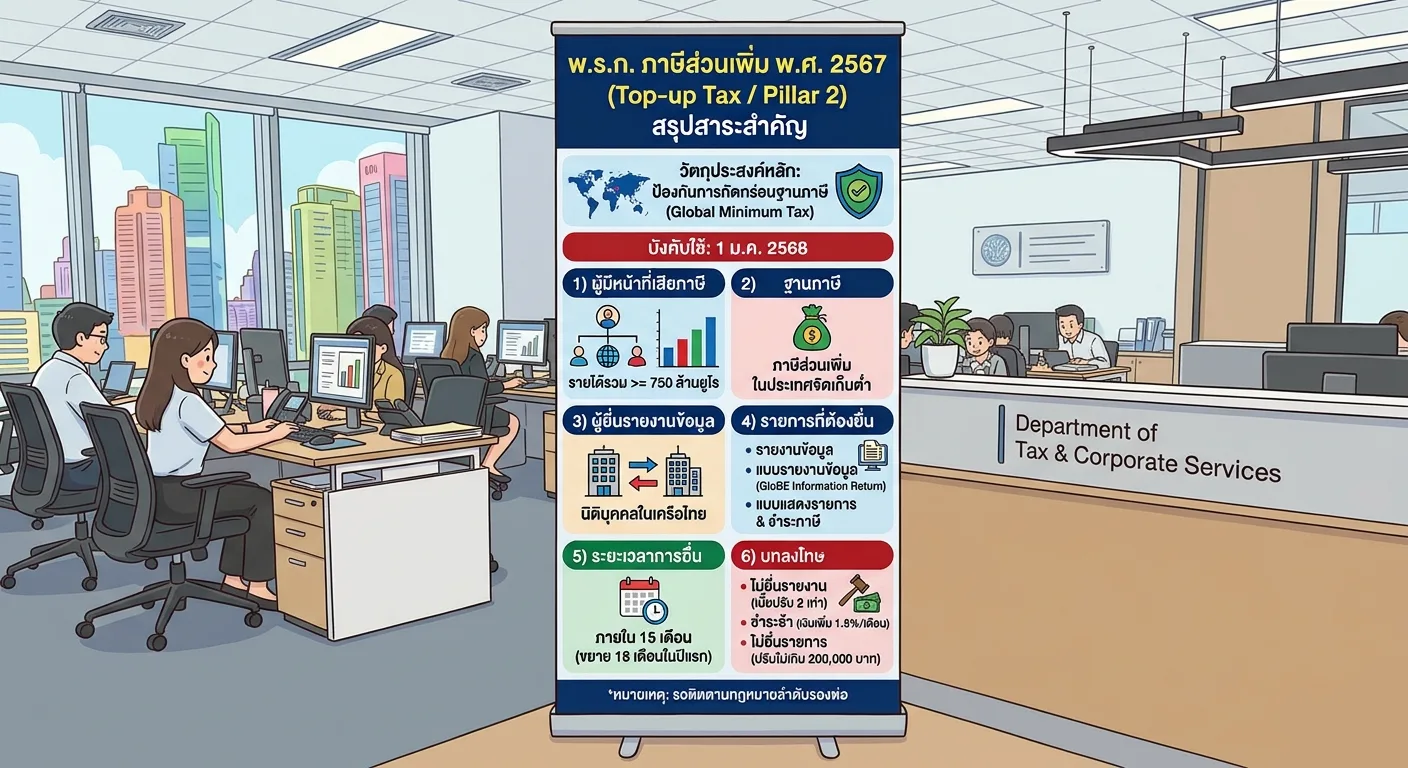
📋 Summary of 6 Key Criteria under the Top-up Tax Emergency Decree, B.E. 2567 (2024)
1. Taxpayers (Entities Subject to the Tax)
Constituent entities located in Thailand that are part of a multinational enterprise (MNE) group with annual consolidated revenues of at least 750 million euros (in at least two of the four preceding fiscal years).
2. Tax Base
The tax base consists of the "Top-up Tax" calculated for each MNE group in jurisdictions where the effective tax rate is below the established threshold.
3. Reporting Obligations
Every constituent entity located in Thailand is required to submit an information report.
Exception: An entity may designate another constituent entity within the same group—provided it is also located in Thailand—to submit the report on its behalf. (The name and taxpayer identification number of the authorizing party must also be provided when submitting the information.)
4. Filings required for the Revenue Department
Information Notification
GloBE Information Return
Supplementary Tax Return and Payment
5. Filing Deadline
Within 15 months from the end of the fiscal year of the Ultimate Parent Entity.
Note: An extension of 3 months (totaling 18 months) is permitted for filings related to the initial year or the preceding year.
6. Penalties, Surcharges, and Additional Fees
Failure to file the Information Return: A penalty equal to twice the amount of the supplementary tax due.
Failure to pay tax by the deadline: A surcharge of 1.5% per month (or fraction thereof) of the supplementary tax amount (excluding penalties).
Failure to submit a report or return without reasonable cause: A fine not exceeding 200,000 THB.