Thailand’s Tax Base Crisis: 12 Million File Returns, but Only 5 Million Actually Pay—with the Burden Concentrated on the Top 1%
While 12 million Thais file tax returns, only 5 million actually end up paying taxes! Latest statistics from the Budget Committee reveal a crisis in Thailand’s tax base, with half of the nation’s total tax burden shouldered by just 1% of the population. What is happening to the country’s revenue structure, and how will the government address this challenge?
Government revenue collection is a critical fiscal issue currently under close scrutiny—particularly personal income tax, where the number of actual taxpayers is worryingly low relative to the size of the working-age population.
Recent data from the Budget Committee regarding personal income tax filings for the 2024 tax year (submitted in 2025) clearly highlight the structural limitations of Thailand’s tax system:
1. Tax Filer Profile: Ten Million Filers, Fewer Than Half Actually Pay
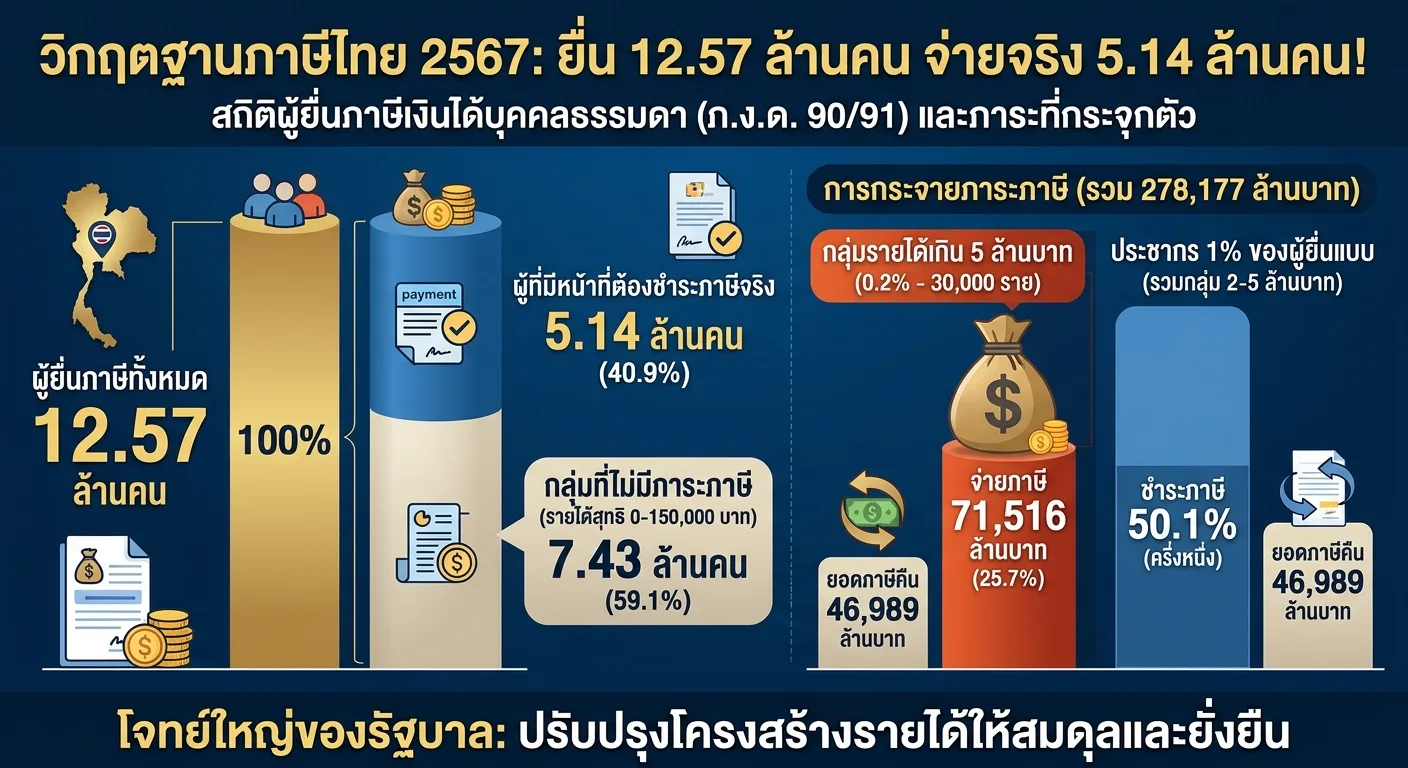
Total number of tax filers: 12.57 million
Those who actually pay tax: Only 5.14 million (40.9%)
Those who do not pay tax: 7.43 million (59.1%), as their net annual income does not exceed 150,000 baht—a threshold that qualifies them for a legal tax exemption.
2. Disparity in Tax Burden: The State Relies on Just 1% of Filers
Of the total calculated tax liability of 278.177 billion baht, the vast majority of the burden falls on high-income earners:
Those with a net income exceeding 5 million baht: Just 30,000 individuals (0.2% of all filers) contribute 71.516 billion baht in taxes (25.7% of the total tax collected).
When including the group with a net income of 2–5 million baht (0.8%), it becomes clear that just 1% of all tax filers... They shoulder a tax burden amounting to 50.1%—or half—of the total personal income tax collected by the state.
3. Overview and Major Fiscal Challenge
Furthermore, the state is required to issue tax refunds totaling 46,989 million baht due to overpayments.
These figures indicate that Thailand’s tax base remains narrow, concentrated among a small group of individuals, while the majority of the population earns below the taxable threshold. This presents a major, urgent challenge for the government: it must prioritize expanding the tax base and reforming the nation’s revenue structure to ensure long-term balance and sustainability.